By Maggie Beamguard
Insider Editor
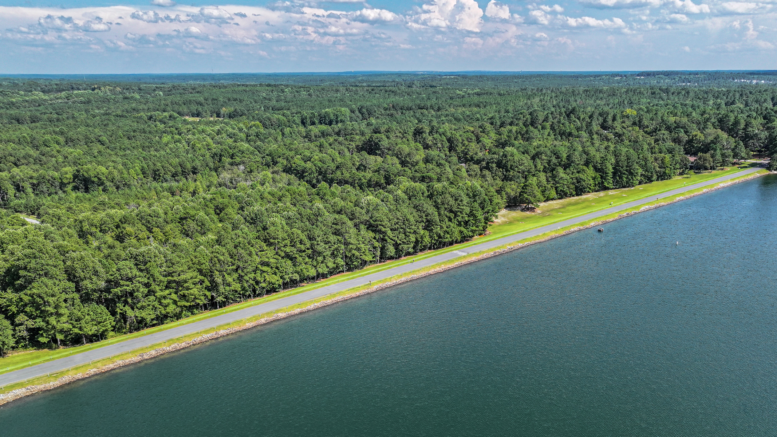
For the first time in six years, north and southside Seven Lakes residents have a date to watch for the state-mandated Lake Sequoia dam project to begin. Sept. 8 is the current target for beginning to lower the lake in preparation for the long awaited project to install a system that will allow the lake to be lowered on demand.
The lake is expected to be lowered three feet from its full point. The current level of the lake as of Aug. 17 was nine inches below full due to natural circumstances such as evaporation. The association will receive credit for the lower starting level. The initial drawdown is expected to take about a week.
The target end date for construction is Feb. 1, but that doesn’t mean the lake will immediately begin filling again. The completed project must first be inspected and approved by the North Carolina Department of Environmental Quality (NCDEQ). The current estimation is that the NCDEQ approval could take up to 60 days, placing the anticipated sign-off around March 31. Only then can the lake begin refilling.
After years of changing requirements and rising cost estimates, Heather Guild, the Seven Lakes Landowners Association board member overseeing the project, is hopeful that the next six months will be a little smoother than the last six years. As a former global category director for a consumer products company, and once responsible for launching products in 63 countries, Guild has a background in managing complex projects.
“I think I’m hoping that getting here has been the most difficult part of this journey,” Guild said. “It has been so long and so stop and start and chop and change. And now that we have a plan, we have a permit, everybody seems to be on the same page.”
Guild said the association’s immediate focus is straightforward: deliver the project on time and at or under budget.
A Long Time Coming
The journey to this point began in 2019 when NCDEQ notified the association that the Lake Sequoia Dam needed a way to lower the lake level on demand.
This regulation was not on the books when the dam was built in 1974. State dam-safety rules requiring such a mechanism took effect in 1978. Now that regulation is being applied retroactively. During heavy and prolonged rains, this ability protects the integrity of the dam.
A lengthy planning process followed as the association navigated changing requirements for how far the lake needed to be lowered, engineering revisions, and revised permit applications. NCDEQ approved the permit in February 2026.
The association then entered the bidding process, ultimately selecting In-Water Services of Greensboro for the construction work.
Now the contracts have been signed. Performance bonds are in place. Liability insurance has been secured. And approximately $250,000 in long-lead materials have been ordered.
To Be Built
The project has been referred to as the “bottom drain project” for years. But the solution approved by NCDEQ isn’t a traditional bottom drain. Instead, the SLLA will install a siphon system.
The existing barrel and spillway will continue to handle normal water release. The new siphon will provide another way to release water when the lake needs to be lowered further. Modern siphon systems have mechanical components to activate the pumping process.
Installing the siphon isn’t a job that can be done from dry land. In-Water Services will deploy a diving team to do the underwater work. Guild said this expertise was one factor in selecting IWS for the project.
In-Water Services will handle construction while J.T. Grimes, the association’s consulting engineer, will provide oversight on the association’s behalf. A second layer of oversight will come from Jeff Allen, a Seven Lakes resident who is a licensed dam engineer.

Three-Foot Drop
While residents have heard that the project could require as much as a ten or 20-foot lake level drop, the current plan calls for three feet.
The three-foot drop will be less disruptive to residents but it also has engineering consequences.
The construction will require a temporary coffer dam, or essentially a barrier that allows workers a dry area in which to work.
A deeper lake means greater water pressure is exerted on the temporary structure. Because NCDEQ approved a three-foot drawdown rather than a deeper one, the coffer dam has to be larger to manage that applied pressure. A larger coffer dam means a high price tag.
But it also means the community avoids the consequences of a 10-foot or deeper drawdown.
“Every little movement one way or the other,” Guild said, “always seems to have a corresponding cost implication.”
In the end, she said, the current arrangement represents a compromise between engineering requirements, dam safety and the community’s desire to avoid a dramatically lower lake.
Timeline
The construction work has been intentionally planned to occur between the end of summer and the beginning of spring. The deliberate timing accommodates residents who enjoy summertime lake activities.
“You lose some of the beautiful Sept. and Oct. weather while the lake is lowering,” Guild said. “But we got the main chunk of time everybody cares about.”
The drawdown is expected to begin on Sept. 8. Construction preparation will include clearing trees and preparing an access site. As construction proceeds, IWS is expected to be on site regularly. Weather could affect the schedule.
With the target completion date set for Feb. 1, the community is positioned to take advantage of spring rains once NCDEQ approves the work. NCDEQ approval could take up to 60 days after construction is complete with the current target for sign-off around March 31 next year.
Daily Impact
While the most obvious change will be the lower lake level, residents will have to adjust to changes around the dam.
Once construction begins, the portion of Firetree Lane running across the dam will be closed to all vehicle, golf cart, bicycle, e-bike and pedestrian traffic. This closure will remain in effect until NCDEQ inspects and approves the work.
The closure is a matter of personal safety and the protection of the work being completed.
As of now, there are no additional boating restrictions, though that could change once construction begins, particularly around the dam itself.
Boat owners should be making preparations for the lower water level now. Boats do not have to be removed from private docks or the marina slips. But depending on the location of the dock or slip and the type of boat, a boat could become grounded.
Boats must be securely tied to a dock or marina slip. Running moorings are not allowed.
For residents who prefer to move their boats out of the lake, the association is offering discounted dry-slip storage at $100 per slip from Sept. through April, subject to availability.

$3.4 Million Cost
The current project figure is approximately $3.4 million. That number is higher than the $3.2 million estimate prepared by J.T. Grimes in June 2025, but Guild emphasized that the $3.4 million figure includes contingency and other project expenses.
The actual construction cost is expected to run approximately $2.5 million with a 15 percent contingency — roughly $400,000 — built into the project.
Additional costs include NCDEQ related fees and technical oversight as well as engineering consulting and geotechnical consulting.
The contingency is built-in in case unforeseen costs arise.
Because the project represents a significant expenditure for the community, Guild has created two financial tracking tools.
The first is an actual-verses-budget spreadsheet. As invoices arrive, the cost of each project phase can be compared with the amount budgeted for that work. The goal is to give residents an idea of how the project is tracking against its budget.
“At any given time, we will know — you will know — over, under, even, in terms of the budget,” Guild said. “All of that will be documented and verified.”
The second spreadsheet is a cash-flow schedule. The association’s finance committee planned for this expenditure partly through investments, making the dollars work for them by earning interest as reserves accumulated. Guild said they have earned more than $250,000 in interest over the past six years.
As the project enters its spending phase, the association needs to know when cash is needed so those doing the work can be paid and investments can be adjusted without incurring unnecessary penalties.
“We’re going to make sure when you invoice us, you will get payment,” Guild said. “You’re not going to have to chase us, because that all goes to: let’s get this thing delivered on time and at or under budget.”
Guild said both tracking systems will be publicly shared and updated.
Residents should be able to see, within a couple of weeks, what phase of the project has been completed, what it cost, whether it is on budget and where the association stands in terms of cash flow.
Getting Back to Full
The project will temporarily inconvenience the community, Guild acknowledged, and she is asking residents for patience, especially when navigating the road closure across the dam.
She also wants residents to know they played an important role in getting the project this far.
“They did vote to have the dues increase last year, and the primary reason for the need for the dues increase was to fund the dam project,” Guild said. “They made it possible for us to move forward because we have the funds.”
Among some residents, Guild, has earned the nickname “Dam Heather.” She doesn’t mind the moniker at all. “They always say it with a wink and a smile,” she said.
As the project communications coordinator, Guild will be keeping the community apprised of the project’s progress.
She plans to provide a one to two page project-status report at least once a month at the board meeting. The report will become a part of the meeting minutes and be posted on the SLLA website, giving residents the opportunity to follow the project’s progress whether they attend the meeting in person, watch online or review the minutes later.
“Hopefully this time next year,” she said, “we will be through it; and we will be compliant; and we will have our lake back — at full pond.”
Contact Maggie Beamguard at maggie@thepilot.com.